

Continuous pulse oximetry monitoring as a coded SpO₂ series
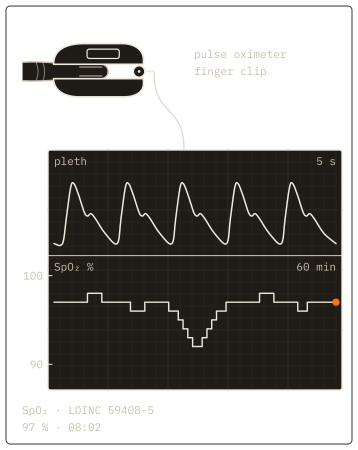
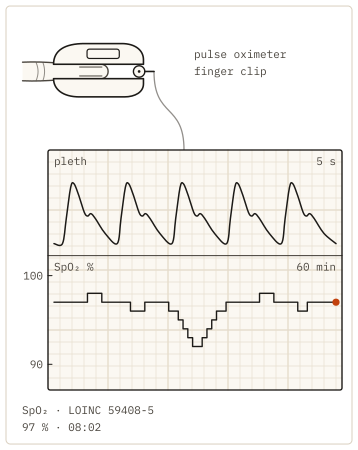
A pulse oximeter clipped to a finger reports oxygen saturation (SpO₂) and pulse rate for as long as it stays on. Kymolog files each value as its own coded reading, timed to the minute it was measured, and leaves the minutes the device missed empty.
LOINC 59408-5 · % · one Observation per reading · FHIR R4
Each SpO₂ value as a coded Observation
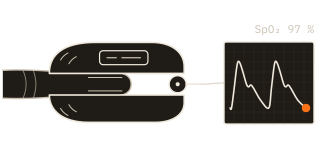
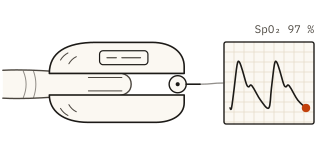
At 08:05 a pulse oximeter at bed W1-3 reports SpO₂ 96 % and a pulse of 74. Kymolog™ files each value as its own Observation, the measurement record in Fast Healthcare Interoperability Resources (FHIR). SpO₂ goes under LOINC 59408-5 in %, heart rate under 8867-4 in /min.
LOINC 59408-5 names the method, pulse oximetry, so these values stay apart from saturation measured on an arterial blood gas. Neither value carries patient details when the agent sends it; the device is assigned to a bed, and Kymolog matches the patient later, inside the install.
Continuous SpO₂ monitoring has gaps: a probe slips off a finger, or a patient unplugs to walk. Kymolog files nothing for those minutes, so the series has an empty interval where the device sent no reading, and no value is carried forward.
Example readings: an hour at one bed, gaps included
Figure 2 as a table
| Stretch | Readings | Observations filed |
|---|---|---|
| 08:00 to 08:20 | 21, one a minute | 21 |
| 08:21 to 08:26 | none (gap) | 0 |
| 08:27 to 08:43 | 17, one a minute | 17 |
| 08:44 to 08:45 | none (gap) | 0 |
| 08:46 to 08:59 | 14, one a minute | 14 |
| Total, 08:00 to 08:59 | 52 of 60 minutes | 52 |
SpO₂ into the EHR
Every four hours on a medical ward, a nurse copies SpO₂ off the bedside display into the flowsheet, and the values in between never reach the chart. Kymolog looks up the patient from the bed: it asks the EHR who was in bed W1-3 at 08:05, then files SpO₂ and heart rate in that patient's chart.
An empty bed, or two patients booked to one bed, holds the reading for review with the status preliminary. Pulse oximeter integration is set per device type, so one unit can send readings straight in while another has a nurse approve each one. Readings reach Epic, Oracle Health (Cerner), MEDITECH, athenahealth, eClinicalWorks, NextGen and Veradigm over FHIR R4 or HL7 v2, as each EHR takes them.
Figure 3 as a table
| Step | What happens | Result |
|---|---|---|
| 1. Device | Device/ox-21 sends SpO₂ 96 % and heart rate 74 /min at 08:05 | no patient on the reading |
| 2. Bed | the device is assigned to bed W1-3 | bed W1-3 |
| 3. Occupant | Kymolog asks the EHR who was in bed W1-3 at 08:05 | Patient/p-041 |
| 4. Chart | both values filed in the patient's flowsheet at 08:05 | SpO₂ 96 %, heart rate 74 /min |
| Exception | nobody in the bed at 08:05, or two patients | held as preliminary in the review queue |
Name the units where patients wear pulse oximeters and the EHR those units chart in. The demo matches a reading to a test patient by bed and files it in a test flowsheet.
Request a demoPulse oximetry data for research
The study copy keeps every reading, one coded record each. A record names the bed, the encounter and the oximeter, down to its unique device identifier (UDI). Pulse oximetry research that counts desaturations below a threshold needs to tell a real dip from a probe that came off. Because gaps stay empty, a minute with no reading never counts as a minute at 97 %.
Reviewers also ask which oximeter took a value and when it was assigned to the bed. Kymolog records both, so continuous pulse oximetry data from several units can be compared device by device.
Get an SpO₂ demo for your units
Tell us which units keep pulse oximeters on all the time, and their EHR. We reply within one business day with times to talk. We then file an hour of SpO₂ for one bed into a test chart, gaps included.