

The devices Kymolog records
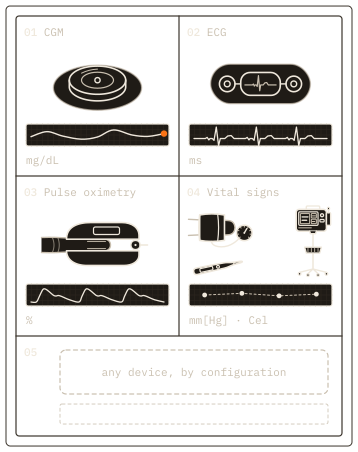
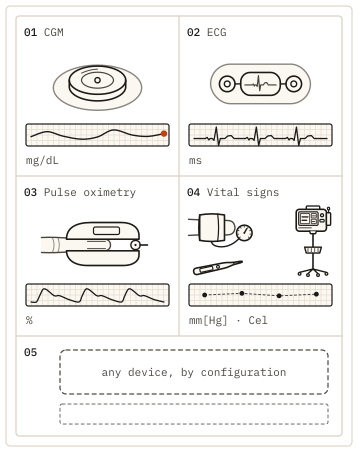
Kymolog comes with LOINC mappings for four device classes: continuous glucose monitors (CGM), electrocardiogram (ECG) monitors and patches, pulse oximeters, and vital-signs cuffs and thermometers. Any other class is added from a manifest file.
4 classes mapped · any other by configuration · LOINC · UCUM
Device classes with their own pages
Each card opens the page for one class. That page shows what the device sends and the LOINC code and UCUM unit the Kymolog™ edge agent assigns. It also shows how those readings reach the EHR and a study dataset.
-
Continuous glucose monitors
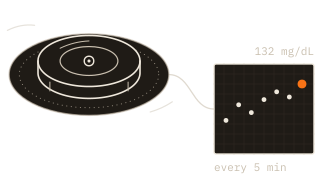
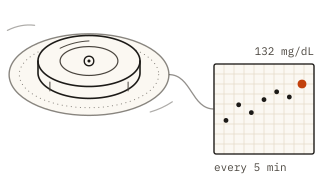
Interstitial glucose in mg/dL under LOINC 99504-3, one value per sensor reading.
-
ECG monitors and patches
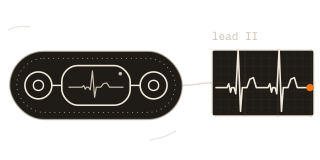
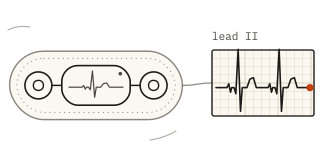
PR, QRS, QT and QTc in milliseconds, with heart rate and the rhythm label, as one coded panel.
-
Pulse oximeters
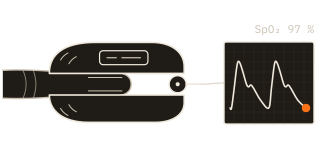
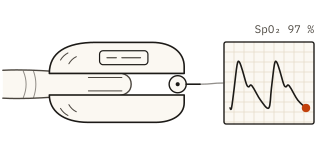
Oxygen saturation (SpO₂), LOINC 59408-5 in %, and pulse rate, kept as a series with its gaps.
-
Vital signs
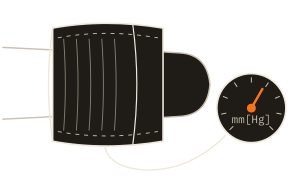
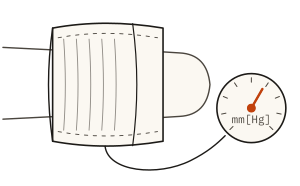
The blood pressure panel, LOINC 85354-9, and body temperature, LOINC 8310-5 in Cel, filed as one set.
The captured fields, class by class
Every value becomes an Observation in FHIR R4, the fourth release of Fast Healthcare Interoperability Resources. The table lists the code and unit each class's values carry. Each Observation also names its device and the time it was measured, and Kymolog then links each one to a patient and an encounter.
| Class | Measurement | LOINC | UCUM code |
|---|---|---|---|
| CGM | Glucose in interstitial fluid | 99504-3 | mg/dL |
| ECG | QTc, the corrected QT interval | 8636-3 | ms |
| ECG | QT interval | 8634-8 | ms |
| ECG | PR interval | 8625-6 | ms |
| ECG | QRS duration | 8633-0 | ms |
| ECG, pulse oximetry | Heart rate | 8867-4 | /min |
| Pulse oximetry | SpO₂ by pulse oximetry | 59408-5 | % |
| Vital signs | Blood pressure panel | 85354-9 | (panel) |
| Vital signs | Systolic blood pressure | 8480-6 | mm[Hg] |
| Vital signs | Diastolic blood pressure | 8462-4 | mm[Hg] |
| Vital signs | Body temperature | 8310-5 | Cel |
The edge agent sets the code before the reading leaves the unit. The EHR interface and the study query then key on the same code, and neither has to translate a device's own labels.
Any other device class, by configuration
A new class starts as a manifest: the LOINC codes it reports, their UCUM units, the normal ranges, and whether values arrive one at a time or as a panel. From that file Kymolog sets up the EHR mapping and the review setting. Onboarding takes 2–4 hours for a device that reports one value, and 4–8 for a panel device.
Wearables join the same way, by class. A wrist sensor that reports heart rate gets a manifest like any bedside device, and its readings carry the same device and time fields.
Get a device list reviewed
Send us the device classes on one unit and the EHR that unit charts in. In the demo we map one of those classes to its LOINC code and file a reading in a test chart. We reply within one business day with times to talk.