

Device data for your hospital customers and your post-market evidence
Hospitals that buy your device expect its readings in their EHR. Kymolog's edge agent gets them there at every site, as coded FHIR R4 data. Each reading also keeps your device's UDI and the time it was taken, so your post-market team can trace every value back to a unit in the field.
UDI · FHIR R4 · LOINC · UCUM
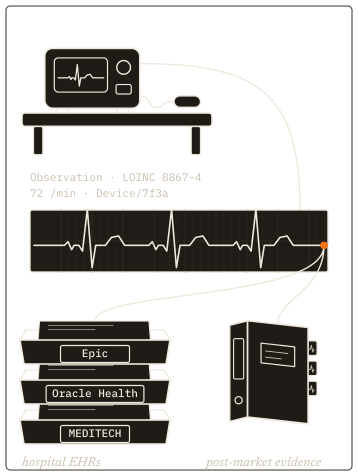
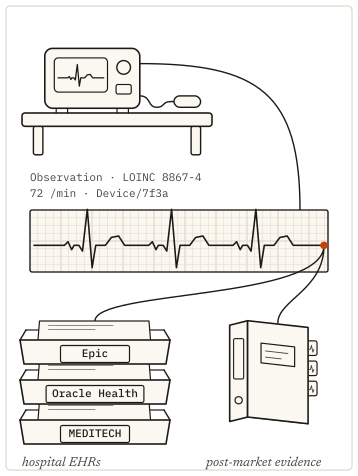
Where real-world evidence for medical devices comes from
Your device takes readings every day in routine care, and hospitals chart them. Those charted values are real-world data, but they usually reach the EHR without their provenance: which unit took the value, when, and during which patient encounter. Without it, a post-market team can't rely on them next to complaint files, registries and published studies.
FDA's final guidance on real-world evidence for medical devices (December 2025) explains how the agency judges whether real-world data is of sufficient quality to generate evidence. Kymolog™ keeps the provenance with each reading from the moment of capture.
Get your device's data into hospital EHRs
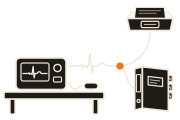
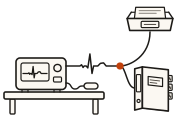
Getting device data to the EHR is a different job at every customer: each hospital runs its own EHR under its own interface rules. Kymolog gives your device one path into the seven EHRs on our list.
Coding at the edge agent
At the bedside, an edge agent takes the values your device already outputs and writes each one in the format EHRs accept: a Fast Healthcare Interoperability Resources (FHIR) R4 Observation. The Observation names the measurement with a LOINC code and its unit with UCUM. Every reading records your device's identity, including its serial number and UDI. Because the agent codes each reading at capture, a measurement carries the same code at every site.
Delivery to each hospital's EHR
Each reading gets its patient and encounter from the bed the device is assigned to at that hospital. Kymolog then files it in the hospital's own EHR: Epic, Oracle Health (Cerner), MEDITECH, athenahealth, eClinicalWorks, NextGen or Veradigm, as FHIR R4 or through an HL7 v2 interface. See the EHRs and delivery paths.
Hosting at the hospital or in your cloud
Each hospital can run Kymolog on its own hardware, or in a cloud account it controls. You can also run it in your own cloud on behalf of those hospitals. Each hospital's patient data then lives in your cloud, under the agreement you sign with that hospital. We only ever receive de-identified readings, for a hosted research store or the data network, because the install de-identifies them before they leave.
Medical device integration with the EMR, without a build per EHR
A direct integration is one build per EHR vendor, followed by mapping, testing and sign-off at every hospital that runs it. An EHR upgrade can reopen the work, and the cost grows with every customer site.
With Kymolog, your device is onboarded once, as configuration: a manifest that lists its measurements, their LOINC codes and their units. Every site then receives the same coded readings, whichever EHR it runs.
Real-world evidence and post-market data
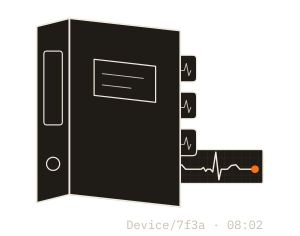
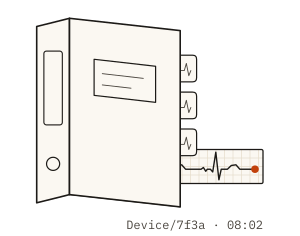
Your post-market team needs the readings the hospital charts, plus proof of where each one came from. Kymolog stores the two together, in the same record.
What each reading carries
Every reading points to the unit that took it: its serial number, UDI, model and device type. It carries a timestamp precise to the millisecond and, inside the install, the patient and encounter it was matched to. It records whether a clinician approved, rejected or reassigned it, by whom and when, and when it reached the EHR. Device-use periods show which patient each unit was assigned to, and for how long.
Kymolog also keeps device health readings, such as battery, signal strength and uptime, so field-performance evidence sits next to the clinical values.
Figure 2 as a table
| Field | Value |
|---|---|
| label: (01) device identifier, the DI | 00614141004126 |
| label: (17) expiration date | 281231 |
| label: (10) lot | L2604 |
| label: (21) serial | SN00412 |
| FDA GUDID | the device record, keyed by the DI |
| Device: udiCarrier.deviceIdentifier | 00614141004126 |
| Device: udiCarrier.issuer | GS1 (gs1-di) |
| Device: serialNumber, lotNumber | SN00412, L2604 |
| Device: expirationDate | 2028-12-31 |
| Device: manufacturer | your company |
| DeviceUseStatement: device, subject | Device/7f3a, Patient/p-041 |
| DeviceUseStatement: timingPeriod.start | 2026-10-01T09:14:00-04:00 |
| Observation: device, subject | Device/7f3a, Patient/p-041 |
| Observation: effectiveDateTime | 2026-10-03T08:02:00-04:00 |
| Observation: code, valueQuantity | LOINC 99504-3, 132 mg/dL |
Post-market surveillance and PMCF
In the US, section 522 of the FD&C Act lets FDA order post-market surveillance of certain class II and class III devices, under 21 CFR Part 822. In the EU, the Medical Device Regulation expects post-market clinical follow-up (PMCF) as part of each device's clinical evaluation. Both call for data from real use.
A site running Kymolog produces that data during routine charting: coded readings from your device in routine care, each traceable to a unit, a time and an encounter. Each hospital decides which of those readings you may use, and in what form, even when the install runs in your cloud. Medical device clinical trials at the same site can use those records too.
Figure 3 as a table
| Step | Where | What happens |
|---|---|---|
| 1 | the site install | the device takes a reading; Kymolog, at the hospital or in your cloud, codes it (FHIR R4, LOINC, UCUM, UDI) and files it in the EHR |
| 2 | the site install | de-identified before it leaves: allowlisted fields, a patient token, dates shifted |
| 3 | data network | consent terms agreed with the site |
| 4 | data network | pooled across sites and licensed to you; royalties paid to the site |
| 5 | your company | the PMCF plan (MDR Annex XIV Part B, section 6) says what data to collect |
| 6 | your company | licensed dataset row: t-8c41, 08:02 (date shifted), LOINC 99504-3, 132 mg/dL, DI 00614141004126, lot L2604 |
| 7 | your company | PMCF evaluation report (section 7), into the clinical evaluation (section 8) and the PSUR (Article 86) |
Our guides cover the obligations in detail: medical device post-market surveillance and PMCF for medical devices.
The data network option
Some device makers need data from more sites than they work with directly. We run the data network as a separate add-on service. Hospitals that choose to take part contribute consented, de-identified device data and earn royalties on it. Device makers and others can license datasets built from that data. How the data network works.
Start with EHR delivery or post-market data
You can start with either one: your device in one customer's EHR, or a post-market data pilot at one site. Both run on the same install, so adding the second needs no new integration. We reply within one business day with times to talk.
Get your device into hospital EHRs Plan a one-site post-market data pilot