
Wearables in clinical trials, with device and time on each reading
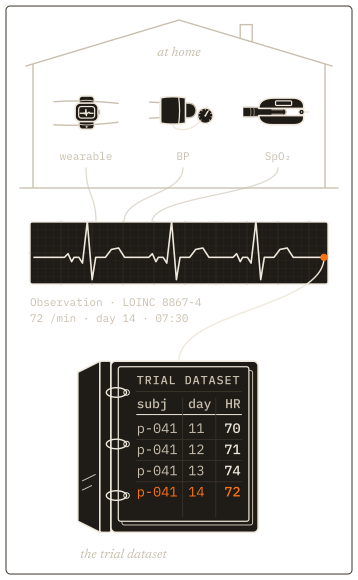
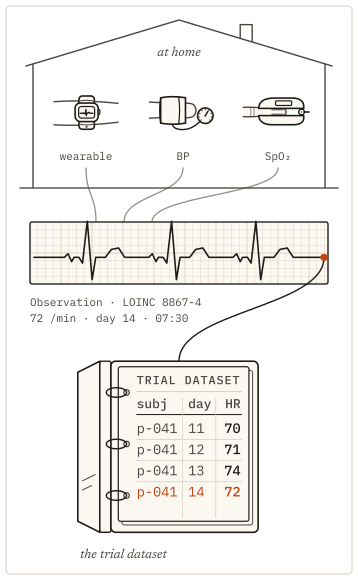
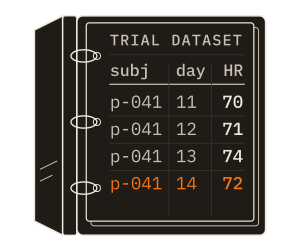
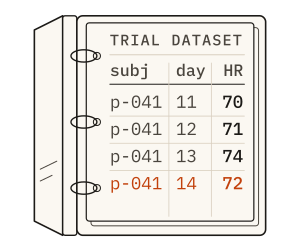
A wearable on a participant's wrist reports a heart rate of 72 at 07:30 on day 14. Kymolog codes the reading to FHIR R4 with LOINC and UCUM, and the trial dataset stores it with the device that took it, the time and the setting.
Device and time per reading · site or home · LOINC · UCUM
Wearable data, coded where it is captured
A continuous glucose monitor (CGM) on participant p-017 reads 142 mg/dL at 07:15 on day 14. The Kymolog™ edge agent records it as a FHIR R4 Observation; FHIR, or Fast Healthcare Interoperability Resources, is HL7's standard for coded health records. The Observation carries LOINC 99504-3, the code for glucose in interstitial fluid, and the value in the UCUM unit mg/dL. It also names the device and the time the reading was taken.
In the trial dataset, the row for that reading keeps the Observation's id. A time-in-range endpoint over days 1–14 then counts rows that each lead back to one reading, one device and one time. Digital endpoints in clinical trials depend on that link to the source reading, as do digital biomarkers in clinical trials computed from the same coded series.
Figure 2 as a table
| Stage | What Kymolog holds | Provenance it keeps |
|---|---|---|
| 1. Capture | CGM reading 142 mg/dL at 07:15:00, worn at home | device Device/c9e2, device time |
| 2. Code | FHIR R4 Observation, LOINC 99504-3, UCUM mg/dL | subject Patient/p-017, device, effective time |
| 3. Dataset | one row of p-017's trial dataset, day 14 | Observation id 5d0b |
| 4. Endpoint | p-017, days 1–14: time in range, LOINC 97510-2: readings in 70–180 mg/dL out of all readings (%) | the rows it counts |
Any device, onboarded by configuration
Your protocol names the devices; Kymolog takes readings from any device via config-driven onboarding. A manifest lists what the device measures, with each LOINC code and UCUM unit, and the edge agent reads the device's own output from then on. Wearables, home blood pressure cuffs, pulse oximeters that read oxygen saturation (SpO₂), electrocardiogram (ECG) patches and CGMs all join this way. DHT clinical trials can then mix device classes in one dataset.
When a protocol allows more than one model, each reading names its model and unique device identifier (UDI), and you can show that the models agree. Kymolog also keeps battery level, signal strength and last-seen time for each device. A gap in a participant's series can then be checked against the device's own record.
Readings from the site visit and from home, in one dataset
At a site visit on 2 October, a monitor in exam room 2 records p-017's heart rate as 68 /min at 09:40. Kymolog ties the reading to p-017 by the room and the time, and links it to the visit encounter. The next morning, a wearable assigned to p-017 sends 74 /min from home over HTTPS, and Kymolog matches it through that device assignment.
Both rows carry LOINC 8867-4 in /min, so they sit in one column. Each row also keeps its setting, its device and how it was matched to the participant. FDA's final guidance on remote data acquisition (December 2023) asks sponsors to evaluate differences between remote and in-clinic measurements. Those three fields support that comparison. Remote patient monitoring in clinical trials and site capture end up in the same table.
Figure 3 as a table
| Setting | Reading | Matched to p-017 by |
|---|---|---|
| site visit, exam room 2 | heart rate, LOINC 8867-4: 68 /min at 2026-10-02 09:40 from Device/vs-02 | location and time; visit Encounter/e-5120 |
| remote, at home | heart rate, LOINC 8867-4: 74 /min at 2026-10-03 07:15 from Device/w-31 | device assignment; sent over HTTPS |
Our walk-through of the DHT guidance maps its other data asks to fields the same way.
The site keeps participant identities
The edge agent carries device values and nothing that names a participant, and Kymolog matches readings to participants inside the install. The site chooses which fields reach the sponsor's dataset, such as a participant number in place of a name.
Wearable data collection runs through the same review queue the site uses for bedside devices. A coordinator can approve, reject or reassign a reading, and Kymolog logs each action with the person and the time.
Show us the endpoints in your protocol
Tell us the endpoint and the device class it depends on. The demo follows one reading from that class into a trial dataset row, then back from the row to the device that took it. We reply within one business day with times to talk.