

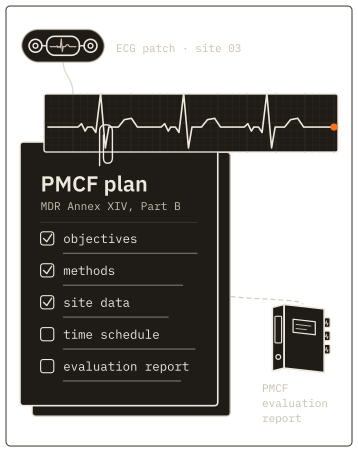
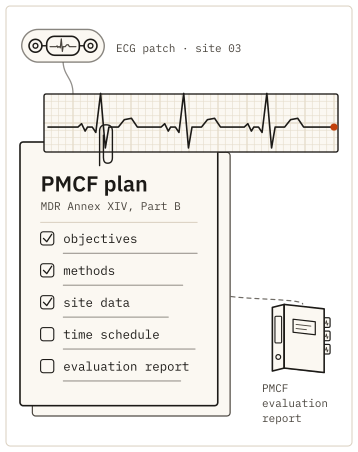
An electrocardiogram (ECG) patch in use at a hospital site sends its readings to the chart all day. Under the EU Medical Device Regulation, Regulation (EU) 2017/745, clinical data includes clinically relevant information from post-market surveillance, in particular from post-market clinical follow-up (PMCF). The patch's manufacturer can collect those readings as PMCF data.
PMCF under EU MDR Annex XIV Part B
Annex XIV Part B of the EU Medical Device Regulation, Regulation (EU) 2017/745 on EUR-Lex, defines PMCF as a continuous process that updates the device's clinical evaluation, addressed in the manufacturer's post-market surveillance plan. The manufacturer proactively collects and evaluates clinical data from the use of a CE-marked device within its intended purpose. The aims are to confirm safety and performance throughout the device's expected lifetime, keep identified risks acceptable and detect emerging risks on the basis of factual evidence.
Article 61(11) ties the follow-up to the medical device clinical evaluation: the evaluation and its documentation are updated throughout the device's life with data from the PMCF plan. For class III and implantable devices, the PMCF evaluation report is updated at least once a year.
A manufacturer that finds PMCF does not apply to a device has to justify that in its post-market surveillance plan (Annex III). Article 83 points the same way from the surveillance side. The data a manufacturer's surveillance system gathers is used to update the clinical evaluation and the summary of safety and clinical performance.
The PMCF plan
Section 6.1 asks the plan to specify the methods and procedures for collecting and evaluating clinical data proactively. Those methods serve five aims:
- confirming safety and performance throughout the expected lifetime;
- identifying unknown side-effects and monitoring known ones and the contraindications;
- finding emergent risks on the basis of factual evidence;
- keeping the benefit-risk ratio acceptable;
- spotting systematic misuse or off-label use, to check the intended purpose is correct.
Section 6.2 sets the minimum content. A PMCF plan includes at least:
- general methods, such as gathering clinical experience, feedback from users, screening the literature and other sources of clinical data;
- specific methods, such as evaluating suitable registers or PMCF studies;
- a rationale for choosing those methods;
- references to the relevant parts of the clinical evaluation report and to risk management;
- the specific objectives the PMCF addresses;
- an evaluation of clinical data on equivalent or similar devices;
- references to relevant common specifications, harmonised standards and guidance;
- a detailed, justified time schedule for PMCF activities, such as analysing the data and reporting.
Naming site device data in the plan
A plan that uses site readings names them as precisely as any other source. It says which device and which measurements, by LOINC code, at which sites and over what period, so the schedule in point (h) can be kept. It also says how each value is traced to its device and encounter, and who at the site reviews readings before they count.
That description supports the rationale in point (c), and later lets the evaluation report show where its numbers came from. When the device runs at several hospitals, the plan can name each site and add more over time. Its variables stay the same, since every site codes the measurement the same way.
Bring your PMCF plan and the name of a hospital where the device is in use. The pilot collects that device's readings at the site, each one traceable to its device, encounter and reviewer.
Plan a one-site post-market data pilotChoosing among a PMCF study, registers, surveys and device data
The methods in a plan fall into the two groups section 6.2 names. A PMCF study is a specific method.
Some studies put subjects through procedures beyond the device's normal use that are invasive or burdensome. Article 74 treats those as PMCF investigations, and the sponsor notifies the Member States at least 30 days before one starts. A study also needs its own protocol and set-up at each site, while readings from an install accrue from the day it goes live.
Registers are the other specific method the annex names. Surveys of users sit with the general methods, as feedback from users. A survey reports what users remember or judge, rather than what the device measured.
Device readings from hospital sites can be one of the other sources of clinical data that the general methods include. They record what the device measured, coded and dated by the device, for every patient it was used on at that site.
The PMCF evaluation report
Section 7 has the manufacturer analyse the PMCF findings and document them in a PMCF evaluation report. That report becomes part of the clinical evaluation report and the technical documentation. Section 8 feeds its conclusions back into the clinical evaluation and into risk management, and the manufacturer carries out any preventive or corrective measures the PMCF shows are needed.
For class IIa, IIb and III devices, the periodic safety update report under Article 86 sets out the main findings of the PMCF. Class IIb and III manufacturers update that report at least once a year, and class IIa manufacturers at least every two years. A PMCF report that cites site readings should let a reviewer follow any value back to where it came from.
Figure 2 as a table
| Stage | What the regulation says |
|---|---|
| PMCF plan (6.1, 6.2) | Methods and procedures for proactively collecting and evaluating clinical data; at least the general and specific methods, the objectives and a time schedule |
| Clinical data (6.2(a), (b)) | Clinical experience, user feedback, literature and other sources of clinical data; registers or PMCF studies. Device readings from sites, with provenance, are one such source |
| PMCF evaluation report (7) | The findings analysed; part of the clinical evaluation report and the technical documentation |
| Conclusions (8) | Taken into account in the clinical evaluation (Article 61, Part A) and risk management (Annex I, section 3) |
| PSUR (Article 86) | Class IIa, IIb and III: sets out the main findings of the PMCF |
| Continuous (5) | PMCF is a continuous process that updates the clinical evaluation |
Site data with provenance
At each hospital site, Kymolog™ takes each reading from the device as it is measured. A continuous glucose monitor (CGM) value of 132 mg/dL is coded as LOINC 99504-3 in mg/dL. It means the same at every site that contributes, so readings pool without remapping.
For a PMCF evaluation, each value has to show four things: which device took it, when, in which patient encounter, and whether anyone changed it. A Kymolog reading names its source device by unique device identifier (UDI). It keeps the serial number and the time the device measured it, links to the encounter found by bed, and keeps every version along with who made each change.
In the dataset the evaluation draws on, each row is one reading. It holds the time and the coded value, with the device, the study subject, the encounter and the reading's status beside it. Subjects appear as study identifiers rather than names.
Figure 3 as a table
| Taken | Value | Provenance |
|---|---|---|
| 08:02 | 132 mg/dL (LOINC 99504-3) | device 7f3a, subject p-041, encounter e-5531, final |
| 08:07 | 137 mg/dL (LOINC 99504-3) | device 7f3a, subject p-041, encounter e-5531, final |
| 08:12 | 141 mg/dL (LOINC 99504-3) | device 7f3a, subject p-041, encounter e-5531, final |
| 08:04 | 96 mg/dL (LOINC 99504-3) | device 9a21, subject p-058, encounter e-5540, final |
| 08:09 | 101 mg/dL (LOINC 99504-3) | device 9a21, subject p-058, encounter e-5540, final |
Exposure and field performance
Readings alone do not show how long each patient wore the device. Kymolog also records device-use periods, the start and end of each device's assignment to a patient. Those periods give the evaluation its exposure, in patients and days on the device, next to the readings.
Each device also reports its own health, such as battery level, signal strength and uptime, and Kymolog keeps those reports as data. A run of dropped connections then sits in the same record as the clinical values around it. Review decisions are kept as well, so a reading a nurse rejected, with the user and the time, counts as a data-quality signal.
Limits of device data
Device readings record what the device measured. They do not record why a clinician changed therapy, what the patient reported, or how the patient fared after discharge. Those questions still need the plan's other methods, from literature and registers to user feedback and PMCF studies, and site readings complement them.
Each hospital decides whether its readings are shared with you, and in what form. It can share them de-identified through the data network, our add-on for sites that consent, or under an agreement it signs with you. The US side of the same question is in the post-market surveillance guide, and the rest of the install is on how Kymolog serves device makers.